

Ultra Reliable Lightwave Orchestrator
Your next market shouldn't start with a building.
URLO engineers fiber transport and power as one hardened outdoor system. The cabinet is the site — so your footprint stops growing every time your network does. Integrated, deployed and supported by AMT.
The trade-off
Two ways to enter a market.
The system
Five pieces, engineered as one.
Any one of these can be bought anywhere. Specified, integrated, staged and supported as a single system — that is the part AMT delivers, and the part a component vendor doesn't.
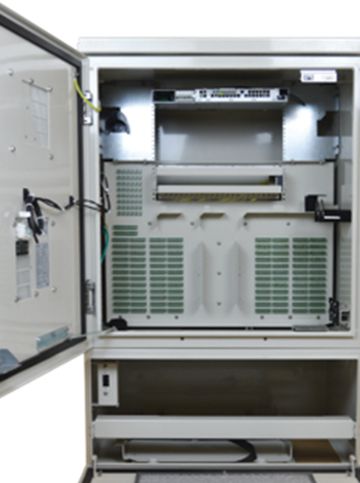
Optical Broadband Cabinet
Hardened outdoor enclosure — the site, without the building.
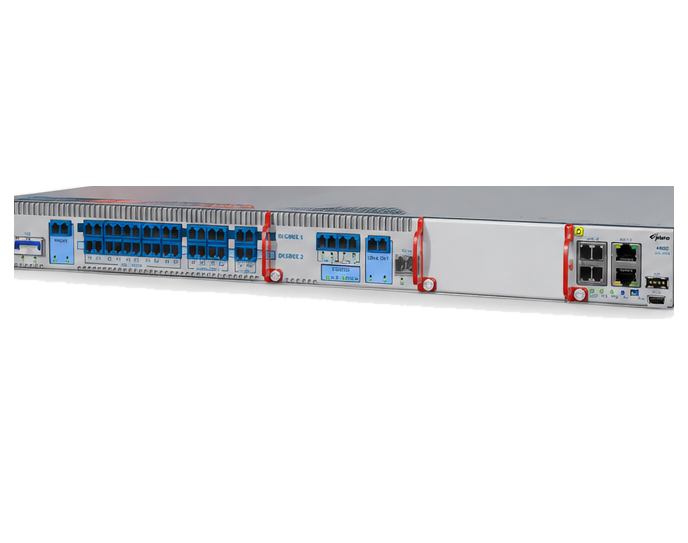
Hardened ROADM
CDC-Flexgrid optical transport, field-rated with no climate control.
Rectifier
Primary power conversion for the whole cabinet.
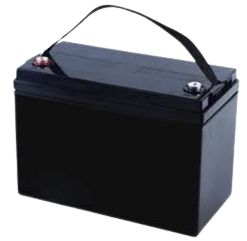
Super Capacitor
Instantaneous ride-through the moment power drops.

Fuel Cell
Extended autonomous runtime when the outage isn't brief.
The transport
Reconfigure the network without sending a truck.
Colorless, directionless and contentionless: wavelengths are added, dropped and re-routed remotely, from a ROADM that is temperature hardened for the field rather than housed in a room that has to be kept cool.
The proof
72 hours off grid. Zero interruption.
Hardened is a claim until something proves it. In a simulated three-day grid outage, the Saber 4400 system — powered by an Upgen NXG fuel cell and hybrid super capacitor — carried the load without a single interruption. The site stayed up while the grid did not.
Why it matters: a site that rides through a multi-day outage on its own power is a site that never generates a truck roll for backup — one less reason anyone has to drive out to a cabinet that was built not to need them.
Where it fits
Four ways operators put URLO to work.
FTTx expansion into new territories
A scalable, cost-effective way into underserved regions, with far less reliance on expensive, climate-controlled hubs.
Hub site reduction
Centralizes manned facilities and cuts the ongoing environmental maintenance cost of every hub carried on the books.
Managing remote generation assets
Built for high volumes of SCADA data from remote sites, at up to 80% less cost than a legacy hub-based approach.
New FTTx revenue
Supports XGS-PON OLTs for residential and business growth, enabling lower-cost expansion beyond the traditional service territory.
The end state
Everything URLO gives you shows up as something you stop doing.
The hardware is what we ship. What you actually get is a site that stops asking you for things — and a footprint that stops growing every time your network does.
lower cost than a legacy hub-based deployment. The number is the proof, not the promise — what you are really buying is a footprint that no longer grows with the network.
The one-pager
Take the URLO data sheet with you.
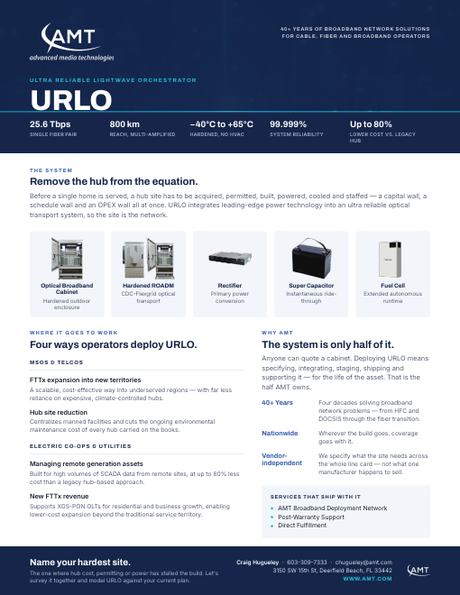
One page you can forward to the people who weren't on the call — the engineer who has to believe the specs, and the CFO who has to believe the number.
- The five components and what each one does
- Transport specs: 25.6 Tbps, 800 km reach, −40°C to +65°C
- The four use cases, split by operator type
- What AMT ships alongside the hardware
 PDF · 1 page
Your download has started.
A copy is on its way to your inbox too. If the file didn't open, use the link below.
Download againNext step
Name your hardest site.
The one where hub cost, permitting or power has stalled the build. Tell us where it is and we'll survey it with you and model URLO against your current plan. One site — not a proposal, not a quote.
- You send the siteLocation, distance to your nearest hub, and what has the build stalled on.
- An AMT engineer picks it upWe come back within one business day with a survey date and the handful of questions we need answered before it.
- We model URLO against your planYour current hub-based numbers, side by side with the URLO build for that specific site.
Your site is with our engineering team.
An AMT engineer will follow up within one business day with a survey date and the questions we need answered before it.